You know those movie—like The Sixth Sense or The Truman Show—where a character undergoes a paradigm shift that completely reframes their understanding of the world? For me, understanding narrative momentum was a shift of the same magnitude.
It changed my entire understanding of what a writer does.
As I’ve argued before, a book is not a story; rather, a book is the most compelling version of a story. Ten different writers will tell the same story ten different ways. And so the conceptual shift from ‘telling a story’ to ‘telling the most compelling version of a story’ is critical because it moves the focus of storytelling from the writer’s intent to the reader’s experience.
The writer is no longer telling a story, they are designing an experience of that story.
The “Moving Body” of Your Story
Conceptually, we can think of this as the difference between building a jungle gym and designing an experience for children at play. Is it the same thing? I don’t think it is. One uses building materials to make a structure; the other anticipates human behavior to craft an experience. One assumes experience will follow from structure; the other knows that structure only serves to facilitate experience.
So, to tell the most compelling version of a story, the writer must master narrative momentum.
Here is a definition: momentum is the quantity of motion of a moving body. So, two important elements: quantity of motion and moving body.
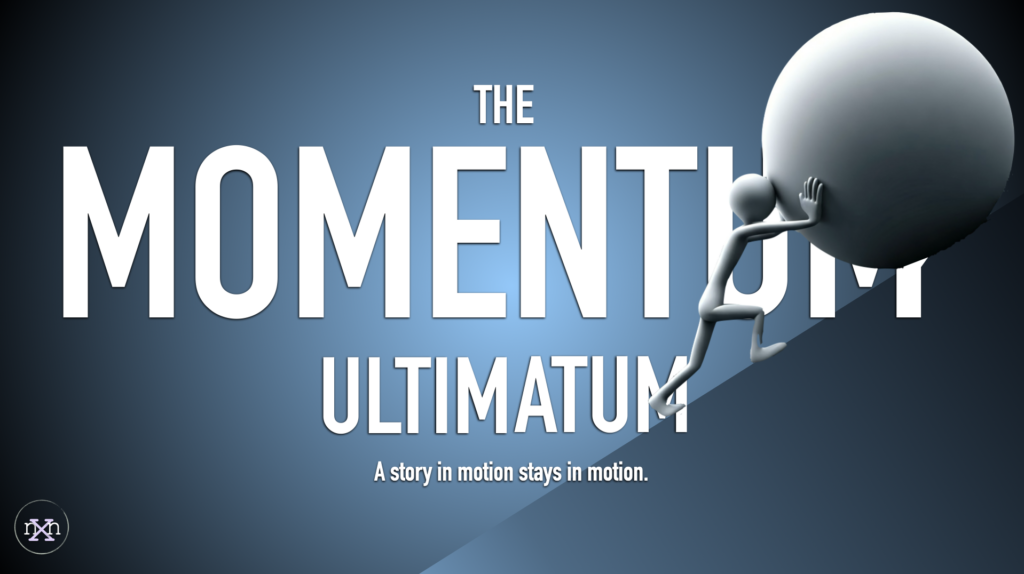
In a story, the “moving body” isn’t the plot—it is the reader’s attention. In other words, the thing in motion—the thing the writer must push through the manuscript line by line and page by page—isn’t the events of the story but the reader’s attention.
We can think of the story as the riverbed and the reader’s attention as the water flowing through it. Or better yet, we can think of the story as an obstacle course and the reader’s attention as the marble rolling down that obstacle course.
The riveting question that keeps a reader turning pages: Will the marble make it to the end of the course?
Cultivating the “Quantity of Motion”
Momentum is the quantity of motion of a moving body. If, in narrative, the moving body is the reader’s attention, what is the quality of motion?
It’s an important question because momentum isn’t just about velocity; it’s about the quantity of motion. You don’t create quantity of motion just by making things move fast; you create it by establishing a starting point and an ending point, and then designing the most engaging route between them.
In narrative, quantity of motion is created and manipulated through any number of techniques:
- Conflict: Creating friction that the ‘marble’ must overcome.
- Subplots: Adding complexity—reversals and midirection.
- Cliffhangers: Designing perilous narrative drops.
- Tone and Pacing: Manipulating the speed and tension of the narrative flow.
This momentum ultimatum applies to every genre. A glacially-paced literary novel with devastating internal conflict (Middlemarch, anyone?) is working every bit as hard—and arguably much harder—to maintain momentum as an alien invasion or whodunit.
But both are guiding the reader’s attention from beginning to end.
The Takeaway
If you can tip a reader’s attention into motion, and if you can anticipate and guide that attention, you can build an experience that feels both inevitable yet surprising.
Just remember that the manuscript is merely infrastructure. Built correctly, it anticipates the reader’s experience. Because the real story happens in the reader’s mind as they navigate the course you’ve built. By shifting your focus from the story you want to tell to the experience you want your reader to have, you’ll discover a new relationship with your story’s ‘body in motion’ as well as with its ‘quantity of motion.’
**This post is adapted from a video I made some time ago.