The Illusion of the Page
Here is something I wish someone had told me a long time ago: a book is not a story.
Most writers I work with fall into two categories. Those in the first group have an idea and are desperate to start putting words on the page. Those in the second group have a draft or a partial draft and have become lost in the wilderness of narrative.
In both cases, my advice is almost always the same: Stop. Stop writing and stop thinking of the problem as a problem of words.
Why? Because words have little to do with the “What” of a story. We can think of words being to writing what currency is to capitalism. On its own, a hundred-dollar bill is just a scrap of linen and ink, valuable only because of the purchasing power it represents. Similarly, words only have value to the extent that they can ‘buy’ the reader entry into the story.
So before we get to writing down words, we need clarity on the “What” of the story.
The Most Compelling Version
When I say a book is not a story, I’m trying to pull back the curtain on a common illusion. A book—or a script—is not a story; a book is the most compelling version of a story.
The number one problem emerging writers face is that they don’t actually know their story yet. They think they do but they don’t. And because they don’t, they are using the writing process to find it. While “writing to find it” is a valid part of the journey, we must not confuse the process of finding a story with the process of telling a story—that is, of rendering the most compelling version of a story.
I like to think of it as baking. There is a big difference between launching into a kitchen project to see if you can somehow produce a macaroon—and knowing exactly what a macaroon requires before executing the steps accordingly.
In other words, if you don’t know the “What” of your story, how can you possibly capture the best “How” of it?
The Iceberg Metaphor
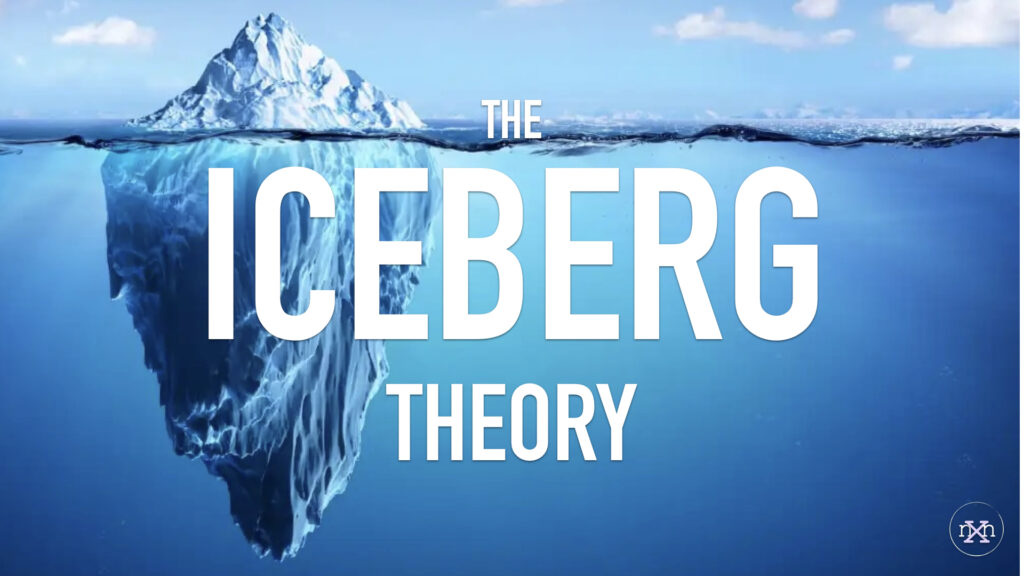
We can imagine an iceberg, where only ten percent is visible above the water. In writing, that visible ten percent are the words—the actual prose and dialogue. It is what the reader can hold in their hands.
But the story itself is the ninety percent hidden underwater. It is much bigger and more complex than the reader will ever know. The writer’s job is to conceive of the entire iceberg—the whole story—and then intentionally design the specific part that will be made visible.
That “design” process is the real work of writing. When you do it well, the actual act of putting words onto a page becomes significantly easier and more impactful.
Don’t Be Precious (with Words)
When a writer has put months or years into a draft but doesn’t actually know what their story is, the realization can be fraught. My position tends to be that while we must be precious with story, we shouldn’t be precious with words.
To a new writer, suggesting that they deletion an entire chapter or a whole draft can feel unspeakably cruel. But just as the crust is not the pie, the words are not the story. The writer who understands this has a huge advantage. If the crust doesn’t come out right, it’s often more efficient to roll it up and start again rather than trying to patch together something that just isn’t working.
Don’t tell a story. Tell the most compelling version of a story. Separate the “What” from the “How.” In moving from finding a story to telling it, the writing will gain not only clarity but purpose and momentum.
**This post is adapted from a video I made some time ago.